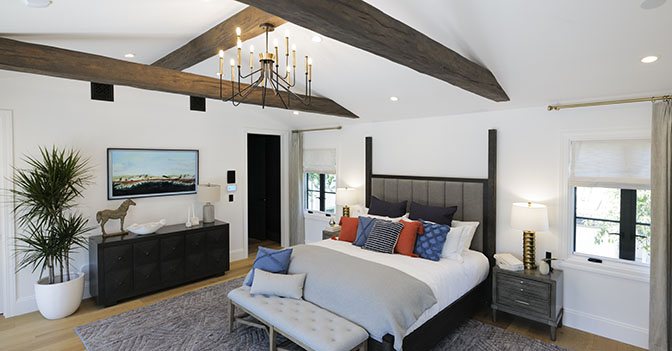
Our ceiling beams are an excellent lightweight alternative to traditional wood beams. In the past, many people would not abandon wood beams to buy a product they did not understand. Now, years later, builders and consumers are realizing the vast advantages of our ceiling beams. Knowledgeable builders and homeowners are demanding that ordinary exterior trim such as wood beams or corbels be made of Polyurethane. They are tired of painting or replacing wood every few years and Polyurethane is simply the logical choice.
Polyurethane is very durable and realistic. It resists chemical attack and severe weather conditions including salt water exposure. Polyurethane is impervious to insects and does not rot. Polyurethane is also environmentally safe, for it contains no atmosphere damaging chlorofluorocarbons.
Polyurethane Ceiling Beams offer ease of installation. The average weight of our ceiling beam is only 20 lbs as compared to the hundreds of pounds a wood beam weighs. Using common woodworking tools and equipment in turn saves labor costs and machinery rentals.
About Polyurethane
The secret of Polyurethane is its closed cell structure. This makes it very stable and keeps moisture from migrating behind coatings. Moisture migration causes serious problems in wood building products (such as wood beams or molding), promoting paint failure and rot. Because of the closed cell structure of Polyurethane, paint tends to last longer and not be lifted off by moisture.
Since the introduction of Polyurethane architectural features nearly thirty years ago, their usage has increased dramatically. When we began making these products at Barron Designs, we would not consider making simple, straight run moldings in Polyurethane. Instead, we concentrated on features which would be very labor intensive and costly if made in wood.
Polyurethane is a petrochemical-based material that substitutes for fiberglass, rubber, latex, silicone, epoxy, and many other natural and synthetic materials — it is preferred in various applications for its high performance characteristics, reasonable price, environmental compliance, and manufacturing efficiency. In an increasingly competitive global economy, manufacturers who can reduce their production, handling, or material cost even slightly while retaining or improving product performance can gain an advantage sufficient to increase market share. Polyurethane products, including polyurea, polyaspartic, and other subcategories, are increasingly found to be cost-effective due to their durability and physical properties, and the demand for this versatile family of materials is growing. Polyurethane chemical composition can be altered to achieve specific physical properties necessary to satisfy product design requirements. The liquid chemical compounds are sprayed, poured, or cast into molds, and the heat generated by the chemical reaction fuses them into Polyurethane products of various densities, textures, and strengths.
Polyurethane is a unique material that offers the elasticity of rubber combined with the toughness and durability of metal. It can be manufactured in a variety of hardness, or durometers, ranging from rubber band soft to bowling ball hard. Depending on the durometer, urethane can elongate up to 800% and returns to its original dimension without a significant loss of memory. Polyurethane can replace either rubber, plastic or metal to create the ultimate material in abrasion resistance and physical properties. Polyurethane is one of the toughest, most wear and abrasion resistant material available today.
Other Advantages
While many rubbers and plastics show excellent resistance to certain solvents, oils, and chemicals, Polyurethane will resist a much wider range of substances. Polyurethanes are therefore more suitable for products or parts that could come in contact with a number of different substances. As with any material, we recommend that Polyurethane be tested for the specific resistance in actual use, or at least on a test that simulates actual use as closely as possible.
- Polyurethane has a closed cell structure which provides protection from moisture and therefore will not rot. Further, the closed cell structure prevents paint from peeling from the surface.
- Polyurethane products provide no nutritional value and as such also resist the growth of mildew and fungus.
- Polyurethane beams (or other molded products) will not crack or warp when properly installed as compared to a real wood beam.
- Polyurethane products are not affected by ultraviolet rays when properly coated. In addition, the finish on our ceiling beams and corbels are treated with an UV prohibitor.
- In special formulations, Polyurethanes can withstand continuous use at 200°C (392°F) or higher. In standard formulations, Polyurethanes are suitable for continuous use up to about 90°C (194°F), although they can withstand temperatures as high as 200°C for short periods in certain applications.
So, as you can see, our Polyurethane ceiling beams (and other castings) offer the most versatility, durability and value for any home building project. We invite you to try our ceiling beams and compare them to real wood beams. We know you will enjoy the benefits.
* * *
Polyurethane products offer pros complex designs with easy installations
"Times have changed," Bob Hazan, a builder in NY, says. "People love
the fact that they can get these beautiful replications of plaster and wood in a lightweight urethane molding that's so easy to install. Today, when we call on the architects with these products they tell us how beautiful they are." The average consumer looks at Polyurethane and thinks it's plastic. But this stains just like wood, it's a lot lighter, and you can put it up using adhesive and a nail gun." Manufacturers also note that Polyurethane moldings offer greater durability, dimensional stability, and freedom and flexibility of design than wood.
Still, skeptics remain. "Some builders don't want to hear about Polyurethane," says Paul Waskey, managing partner with Baltimore architectural product distributor Manor Style Ltd., noting that some pros are convinced that there is nothing better than wood. But, he adds, "Once they start using it, they're hooked. There's no question that it's best when you get into the more intricate detail ... you don't have to go around the room four times building up the moldings."
Design Counts
Polyurethane moldings can be manufactured to resemble high-profile, intricate moldings and can offer 3-D, sculptured looks. "Their claim to fame is that they can duplicate virtually any millwork piece that's out there, whether a simple or very complex molding, even a crosshead or pilaster. Manufacturers are going far beyond the standard crown molding, offering everything from wall niches and pediments to ceiling medallions, domes, and entryway surrounds. They also are branding some of their products. We now can make a Polyurethane product that wouldn't have been possible with wood.
Another reason why pros are turning to urethane products is because they're natural looking. Builders are saying "I have samples here of a faux finish and stained Polyurethane product and you can stand 3 inches from it and not be able to tell it's not wood."
In addition, Polyurethane beams, moldings and corbels are lightweight. That, in turn, translates into significant labor cost savings for builders and remodelers, says Hazan "Because these Polyurethane ceiling beams are lighter than wood beams you usually only need one person to install them," he says. There is one other advantage: Some Polyurethane moldings and ceiling beams come in lengths as short as 6 feet 6 inches, so they can be shipped via UPS or FedEx. But they also come in 16- to 20-foot lengths, which helps avoid butt joints between corners."
The rising price of wood is also driving builders to urethane alternatives. "More and more of what I'm installing [is] Polyurethane," says Hazan. "Wood has gotten pretty pricey. Once you get any more complex or elaborate than a simple molding profile, it's much more cost effective to go with Polyurethane."
Lightweight
|
|
Easy Handling |
| Earth Friendly |
Won't Rot |
|
Termite-Proof
|
|
Pest-Proof
|