Posts Tagged ‘DIY’

22nd September

Luxurious Ceiling Design with Faux Wood Beams

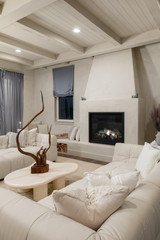
Attention to detail is the secret to a luxurious look. That’s a truth demonstrated by one of our customers from Biloxi, Missouri; who used our Tuscany beams to frame her stunning fireplace with a luxurious ceiling design.

This ceiling design was bare and lackluster before the faux wood ceiling beams were added.

Before, Charlene's ceiling was kind of bare and luckluster.

If there’s one thing Charlene Moschella knows, it’s luxury. As part of the emerging luxury property industry in Biloxi, Missouri, she has an eye for detail and a knack for interior design. That much is obvious in the unorthodox way she approached adding a fireplace to her stunning living room.

For most of us, the only thing needed to add a fireplace centerpiece would be the fireplace itself. For others, with more of eye for design, accessories like faux stone panels could give them the look they were going for. Charlene, however, went a step further.

She used our Tuscany Faux Wood Beams as a stunning addition to her ceiling; which simultaneously created a breathtakingly subtle framing mechanism to draw the eye straight to the newly installed fireplace at the far wall of the room.

The look works so well because Charlene created her ceiling design from two different thicknesses of our faux wood beams. Molded from durable polyurethane, Tuscany Faux Wood Beams are available in widths and depths from 4” across, to over 13”.

That meant Charlene was able to install two thick horizontal beams as the “supports” (even though they didn’t actually support anything) and then run thinner beams across the angled room; giving the impression of a structural, practical framework that had been there as long as the roof had.

A luxurious ceiling design created with faux wood beams.

This strategic use of faux wood beams directs the eye right to her fireplace.

Perhaps the most subtle design cue, though, was the way Charlene left the gap between both horizontal beams bare. Some designers might have been tempted to bridge that gap with more beams – perhaps of the same width as the ones running down the angled ceiling.

But by leaving that bare channel between both sides of the ceiling, the beams act like gun sights; directing the eye towards the fireplace without distraction.

Check out the before and after pictures and tell us what you think of Charlene’s inspired ceiling design. Have you got any tips or tricks about how to focus people’s eyes when they enter a room? We’d love to hear about them; or see any pictures you have.  Send us a message to info@fauxwoodbeams.com. We may even feature them here!

Post to Twitter Post to Delicious Post to Digg Post to Facebook Post to MySpace Post to StumbleUpon

3rd March

The Secret of the Simulated Wood Beam

It’s no secret that our simulated wood beams look amazing – often as good as the real thing. That’s certainly what we hear from our customers, like Jennifer; who wrote “people look at us in disbelief when we tell them they aren’t really wood!” The Bigbie family even boasted: “They’re so realistic it’s uncanny.”

But what’s the secret to our simulated wood beam? How do we get it to look so breathtakingly realistic?

Simulated Wood Ceiling Beam

Simulated wood beams are perfectly molded from the real thing

The first step is to find real wood and timber to copy from. We start with truly beautiful examples of the wood we want to copy, and then use state-of-the-art techniques to capture every intricate detail and texture perfectly: persevering them forever in very durable, high-density polymer.

Our techniques allow for an unprecedented level of detailing; right down to knots in the wood and individual hand-tooling marks. Our customers aren’t exaggerating when they say it’s almost impossible to tell them apart from the ‘real thing’ by looks alone.

Following molding, we either leave the beams unpainted (you can finish them yourself with stain or paint) or color them in a variety of natural-looking shades that are practically impervious to color degradation. This allows you to keep exactly the same color and texture no matter how many feet of beam you intend to install – something that’s not always possible or practical when using real wood or timber beams.

It’s this painstaking production process that results in the incredible realism of each simulated wood beam – practically indistinguishable from the ‘real thing.’ What does set them apart, however, is their practicality.

Our beams are painstakingly colored to resemble the real thing

Ease of installation and affordability mean you can bring the classic elegance of wood and timber beams to rooms in your home that would be impossible to install solid, real wood beams in. In addition, our beams are completely impervious to the elements – something that real wood isn’t.

This gives you immense flexibility in where to install them – from corbels and leg ends on the exterior of your home, to beams in your kitchen, bathroom or basement. To added piece of mind, our Custom Woodland, Raised Grain, Rustic and Rough Sawn beams can be ordered as Class A Fire Rated (this will add 15/20% to their price.)

So it’s worth remembering that our simulated wood beam doesn’t just look ‘as good as the real thing.’ In many ways, it’s actually superior.

Post to Twitter Post to Delicious Post to Digg Post to Facebook Post to MySpace Post to StumbleUpon

11th February

Top 10 Advantages of Fake Wood Ceiling Beams

  1. They’re affordable: Real timber beams, especially aged or distressed ones, can be monumentally expensive. Fake wood ceiling beams give you the same look at a fraction of the price.
  2. Faux Wood Beams Can Transform a Room

  3. They’re stylish: From ceiling logs to aged Yosemite timber, there are fake wood beams to suit any style of construction project. One of the best features of our polyurethane wood beams is that you can buy them unfinished, and stain or paint them all to match perfectly – which can be tricky when using real wooden beams.

    Molded from Real Timber

  4. They’re authentic: Our fake wood beams are molded from real timber, complete with real tooling marks, which means they look absolutely authentic. Once installed and stained (if you didn’t buy the pre-finished) most customers agree that the only way to know they’re not the ‘real’ thing is to reach up and touch them.
  5. They’re easy-to-install: A solid timber beam needs bracing to install safely. Our fake ceiling beams, or reclaimed wood beams, can generally be installed with just construction glue and screws.
  6. They’re lightweight: A solid timber beam can weigh hundreds of pounds, and requires a number of people and some specialist equipment to install safely. In contrast, faux wood beams are light enough that two people can safely install them.
  7. They’re versatile: Creating a cathedral roof? Trying to get the look of exposed wooden beams where none exist? Creating an arbor? Adding a mantel? Faux wood beams are only really limited by your imagination. Check out our photo gallery and testimonials to see some of the amazing design projects people have completed using faux wood beams.
  8. They’re weatherproof: Our fake wood beams are 100% polyurethane, which means they’re waterproof and can resist the elements in a way real timber just can’t. If you’re installing our beams, or accessories like corbels or planks, on the exterior of your home, an application of high quality clear coat exterior polyurethane with a UV inhibitor will keep the color from fading for years to come.

    Hollow, Lightweight, Versatile

  9. They’re insect-proof: Just ask anybody who works with real timber beams and you’ll hear horror stories about termites, woodworm or hornet’s nests buried in wooden beams. By contrast, our fake beams are made from tough polyurethane and the hollow design protects against insect infestation.
  10. They’re hollow: You can do things with fake wood beams that would be impossible with solid wooden beams – like use them to run hidden ducting or electrical wires, or for installing recessed lighting.
  11. They’re ‘green’: If you care about the environment, our faux wood beams are a perfect alternative to cutting down trees. We also make our faux wood beams from polyurethane, not Styrofoam, so our manufacturing process is a lot better for the environment. We don’t use CFCs or formaldehyde during production, and all our stains and finishes are 100% water-based.

Post to Twitter Post to Delicious Post to Digg Post to Facebook Post to MySpace Post to StumbleUpon

23rd April

How to install a corbel

Corbels can enhance the exterior of a structure as well as the interior of a residence or business. They add elegance integral to the beauty of classic design, and create an entirely new presence in a room or on an exterior.

Adding a Faux Wood Corbel to your project may be easier than you think. Check out the guide below to see how one can be added to your project in just a few simple steps.

1.   2.   3.
   
         
Measure the inside dimensions of the corbel.   Cut a Block of wood (not supplied) to fit the inside dimension of the corbel.   Install the block of wood where you want the corbel to go.
         
4.   5.   6.


Apply the industrial strength glue or PL premium construction adhesive on the edges of the corbels.   Slide the corbel into place over the block of wood.   Use screws through the corbel into the block of wood on both sides of the corbel.

Countersink the screws slightly.

Screws hold the corbel in place while the glue dries

         
7.        


Fill in the screw holes with the colored caulk or colored wood filler.

Finished!


Post to Twitter Post to Delicious Post to Digg Post to Facebook Post to MySpace Post to StumbleUpon

16th April

Recent additions to our YouTube account

If you don’t already know, we have a YouTube account where we post many of our helpful DIY and informational videos. We’ve recently added a few new ones that we think you would enjoy. Please check it out.

Post to Twitter Post to Delicious Post to Digg Post to Facebook Post to MySpace Post to StumbleUpon

22nd April

Helpful Tip Tuesday: Let There Be Light

Install hidden uplighting in your beams

Install hidden uplighting in your beams

It goes without saying that faux beams add a warm woody glow to your room. But they can also help add the glow of real light.

The hollow part of the beam is a great place to hide electric wires and route them to light fixtures mounted inside or on top. The three photos show three different ways of lighting up your beams.

Hiding uplights inside the hollow of the beam

The first photo shows suspended beams (attached only at their ends) with lights inside the hollow part, casting indirect light up at the ceiling. These could be fluorescent strips, rope lights, track lights — whatever gives the effect you want.

These beams are short and hefty, so they’re able to bear the weight of the light fixtures without additional support.

Mounting tracklights along the beam top

Track lighting in beams adds versatility

Track lighting in beams adds versatility

The second photo shows exposed tracklights along the top of a suspended beam. This is a much longer suspended beam than in the first photo, and it’s supported by doubled 2x6s inside the beam. (Our website explains how to install a long suspended beam.)

The tracklights, then, mount to the 2x6s — not to the beam itself. Because of this, you don’t need to worry about the weight or size of the fixtures.

Installing recessed lights in the beam bottom

The third photo shows recessed lights in the bottom of attached beams. You install them just as you would in a plaster or drywall ceiling. Our website gives detailed instructions for installing recessed lights .

Recessed beam lighting

Recessed beam lighting

Of course, you have to choose fixtures small enough to fit in the hollow part of the beam. And they must be rated “IC” for direct contact with insulation.

In this case the beam itself carries the weight of the fixtures, so it’s important to attach the beam securely to the ceiling. Be sure to use construction adhesive along the top edges — which also prevents stray light from escaping at the beam/ceiling joint.

Post to Twitter Post to Delicious Post to Digg Post to Facebook Post to MySpace Post to StumbleUpon

14th April

Helpful Tip Tuesday – Handling Your Hangups

Question: Can I hang stuff on a faux beam? Like a swag lamp or planter, or even a ceiling fan?

Answer: Only if you attach it to a solid anchor inside the beam.

Polyurethane beams are tough and durable, but they don’t have the holding power and rigidity to carry additional weight on their own.

Mounting the BlockIt’s tempting to think of attaching a ceiling hook to the bottom of the beam with a toggle bolt, just as you would to a drywall ceiling, and hanging a plant or swag fixture on it. Resist the temptation.

The right time to think about hanging things from a beam is when you’re installing the beam. Imagine where you might eventually want to hang that planter or swag, and provide solid backing inside the beam at that location.Tracing the Backer Block

First attach a mounting block to the ceiling, screwed into a ceiling joist if possible. Then cut a backer block that just fits inside the beam, and screw that block to the side of the mounting block. Don’t forget to write down its location for later reference (“24.5 inches from the west wall”). Then you’ll be able to screw your ceiling hook through the beam and directly into that solid backer block.Cutting the Backer Block

What about permanent light fixtures or ceiling fans? Since they require electrical boxes, you need to plan and install them at the same time you install the beam.


Installing a Light Fixture


You’ll find complete instructions for mounting a chandelier or hanging light fixture on our website. For a ceiling fan, follow the same instructions, but make sure you attach the anchoring blocks directly to a wood joist and not just to the surface of the ceiling.

Post to Twitter Post to Delicious Post to Digg Post to Facebook Post to MySpace Post to StumbleUpon

17th March

Helpful Tip Tuesday – A Little Screwed

Square Drive ScrewAs you may already know, you install faux beams by first attaching several wood blocks securely to the ceiling or wall, and then attaching the beam to the blocks. The blocks are inside the hollow beam, so they’re completely hidden.

What’s not completely hidden are the screws you drive through the sides of the beam into the blocks. You have to countersink them a little into the beam and then fill the holes with matching caulk or wood putty. Or do you?

If you’re like me, the first impulse you have when you need to screw something in place is to grab for a box of drywall screws. They’re cheap and they’re handy. But hold on. Using finish screws instead can make hole-filling easier or even eliminate it.

Finish screws, or trim screws, are flathead screws with smaller heads than normal. Some have Phillips heads, but the ones with Robertson square-drive heads are even better. Square Drive HeadIt’s too easy to strip the smaller (#1) Phillips slots. If you don’t already have a square driver, you can pick one up where the screws are sold. Sometimes the box of screws includes a free driver bit.

Finish screws are also available in colors. If you can match the color of your beam closely enough, and the beam is high enough up that you can’t see the small screw heads from the floor, you might get away with not having to fill any holes.

If that little cheat won’t work, at least you’ll end up with smaller holes after you countersink the finish screws. Smaller holes are much quicker and easier to fill, and harder to see.

In this case, smaller is better.


Screw Against BeamCloseup of Screw Size


Post to Twitter Post to Delicious Post to Digg Post to Facebook Post to MySpace Post to StumbleUpon

Twitter links powered by Tweet This v1.8.3, a WordPress plugin for Twitter.